Why Refractory Decision Makers Must Rethink Material Handling Today
In the refractory industry, operational performance is tightly linked to timelines, precision, and reliability. Whether supplying steel plants during shutdowns or supporting cement kilns with critical lining materials, refractory manufacturers operate in an environment where delays are not just inconvenient; they are expensive.
For decision makers, the challenge is clear:
How do you ensure consistent output, safety compliance, and cost control while operating in one of the most demanding industrial environments?
The answer often lies in an area that is underestimated —material handling systems.
🔍The Business Risk Behind Inefficient Lifting
In many refractory plants, lifting systems are either:
- Underspecified for current load demands
- Not designed for continuous duty cycles
- Struggling in dust-heavy and high-temperature environments
This creates hidden but significant risks:
📉 Direct Business Impact:
- Unplanned downtime affecting production schedules
- Delayed dispatches during critical customer timelines
- Higher maintenance costs due to accelerated wear
- Safety incidents leading to compliance and liability concerns
- Product damage from poor load control
In shutdown-driven industries, even a few hours of delay can result in loss of credibility and financial penalties.
⚙️ Why Equipment Fails in Refractory Conditions
Refractory operations are fundamentally different from other manufacturing environments:
- Materials are dense yet fragile
- Processes involve high-frequency lifting cycles
- Environments are abrasive, dusty, and heat-intensive
Lifting systems fail because they are not built for:
- Continuous usage under stress
- Precision handling of sensitive loads
- Long-term durability in harsh conditions
For decision makers, this results in a cycle of reactive maintenance and operational inefficiency.
🔧 Engineered Solutions That Align with Refractory Business Needs
To break this cycle, lifting systems must be viewed as a strategic investment, not just equipment.
🏗️ EOT Cranes: Ensuring Throughput and Plant-Level Efficiency
EOT cranes directly impact how efficiently materials move across your plant.
🔧 Technical Capabilities:
- Capacity: 1T to 70T+
- Span: up to 35 meters
- Engineered girders for low deflection and high stability
- Smooth trolley movement for controlled load handling
- Advanced safety features including overload protection and limit switches
🔹 Configurations for Refractory Plants:
- DGEOT: For heavy precast refractory components and bulk loads
- SGEOT: For moderate load handling with optimized cost efficiency
- USGEOT: For low headroom plants, maximizing infrastructure utilization
💼 Strategic Impact:
- Faster inter-bay movement
- Reduced reliance on manual handling
- Improved plant layout efficiency
- Lower risk of load-related damage
🪢 Wire Rope Hoists: Reliability Where It Matters Most
For core lifting applications, performance consistency is critical.
🔧 WRH I II III Hoists:
- Capacity: 1T to 10T
- Designed for high-duty (Class IV) operations
- Dual-speed operation for precision
- Robust gear systems for long-term durability
🔧 HW Wire Rope Hoist:
- Capacity: up to 40T
- IP55 protection for dust-heavy environments
- FEM/ISO compliant modular design
- Fail-safe braking and overload protection
💼 Business Impact:
- Reduced downtime due to robust construction
- Better load control minimizing product loss
- Lower maintenance frequency
- Consistent performance in harsh conditions
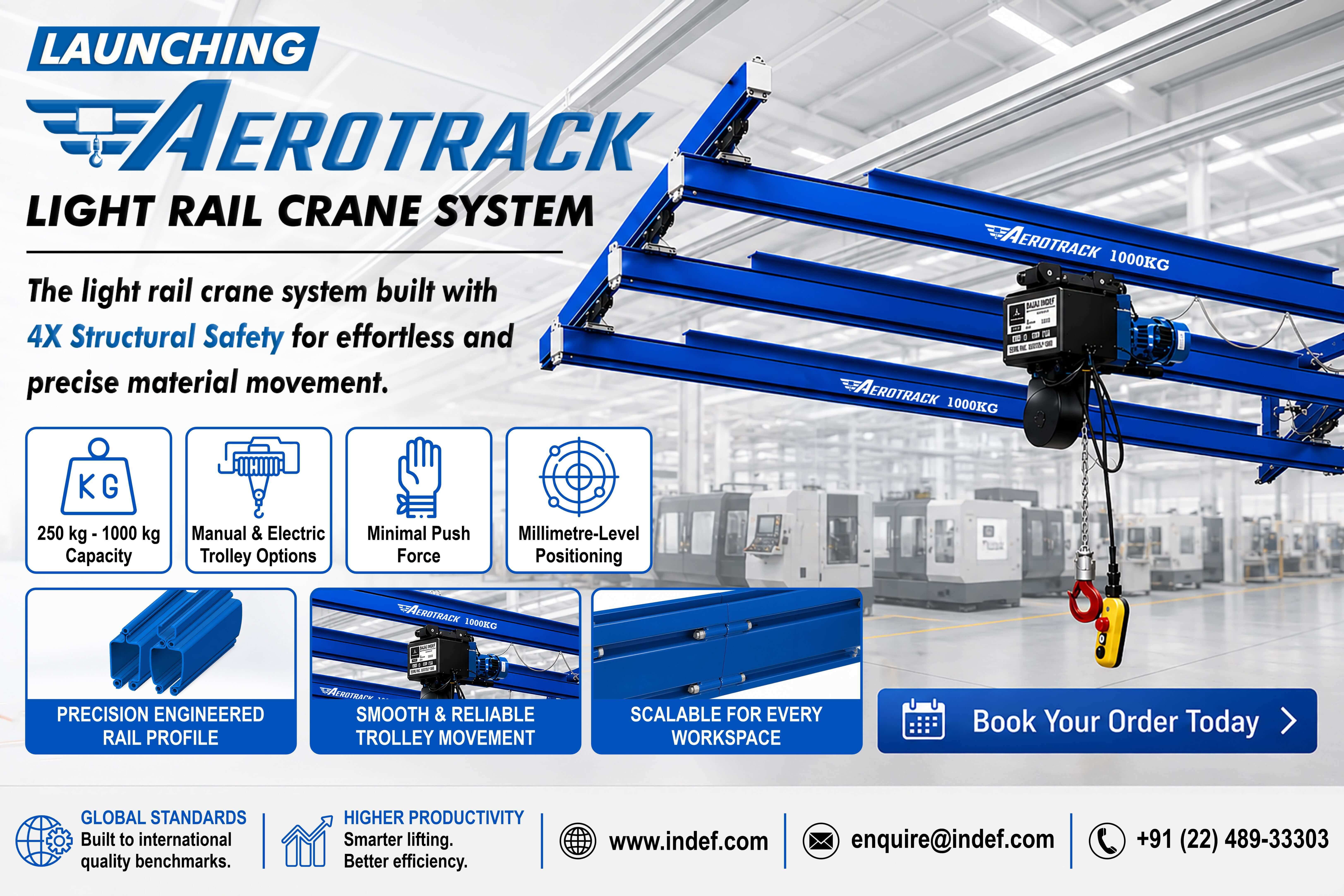
🏗️ JIB Cranes & Light Rail Systems: Improving Operational Efficiency
While EOT cranes and hoists handle primary loads, localised efficiency also impacts overall productivity.
- Enable quick and precise handling at workstations
- Reduce dependency on main cranes
- Improve turnaround time in critical zones
- Ideal for repetitive material movement
- Reduce manual effort
- Ensure consistent workflow across stations
📊 Case Study: Proven Impact on Refractory Applications
🔹 High-Frequency Mixer Operation
A global refractory manufacturer faced:
- Continuous lifting of jumbo bags
- Need for precise placement into mixers
- Zero tolerance for delays
✅ Solution:
WRH II Wire Rope Hoist
📈 Business Outcome:
- Improved material flow consistency
- Reduced interruptions
- Higher process efficiency
🔹 Mold Handling in Corrosive Environment
A refractory solutions provider required:
- Handling customized molds
- Reliability in dust and corrosion-prone conditions
✅ Solution:
HW Wire Rope Hoist with protective coating
📈 Business Outcome:
- Reduced maintenance costs
- Increased equipment life
- Consistent operational performance
📈 From Operational Bottleneck to Strategic Advantage
For decision makers, the shift is clear:
| Traditional Systems | Engineered Solutions |
| Reactive maintenance | Predictable performance |
| Frequent downtime | High uptime |
| Safety concerns | Built-in safety |
| Rising costs | Controlled lifecycle cost |
Material handling evolves from a cost center to a productivity driver.
🔄 Preparing for Growth in the Refractory Industry
With increasing demand from:
- Steel sector expansion
- Infrastructure development
- Cement and power plant modernization
Refractory manufacturers must align operations with:
- Higher production targets
- Stricter safety norms
- Faster turnaround times
This makes reliable lifting infrastructure a strategic necessity.
✅ Conclusion: The Right Investment for Long-Term Performance
In refractory operations, reliability is directly linked to profitability.
Investing in engineered solutions such as:
- EOT Cranes
- Wire Rope Hoists
- JIB Cranes
- Light Rail Systems
ensures:
- Higher uptime
- Improved safety
- Reduced operational disruptions
- Lower total cost of ownership
For decision makers, the question is no longer whether to upgrade — but how soon.
📞 Ready to Strengthen Your Refractory Operations?
Take control of downtime, safety, and operational efficiency with the right lifting solutions.
Connect with Bajaj Indef’s experts for a customized approach tailored to your plant.
📞 +91 (22) 489-33303
📧 enquire@indef.com
Don’t Let Lifting Challenges Disrupt Critical Refractory Operations
This Blog Covers:
How inefficient lifting systems impact plant performance and profitability
• Why decision makers must prioritize reliability and safety in operations
• The role of engineered lifting solutions in reducing lifecycle costs
Copyrights © 2026 - All rights reserved
Get connected