Roll Out Racks: A Complete Guide to Heavy-Duty Industrial Storage
Industrial storage & retrieval becomes challenging when the material is heavy, long, bulky or difficult to access. Pipes, bars, sheets, tubes, dies, moulds and rolled sections cannot always be stored efficiently on conventional shelves or directly on the floor. As material volumes increase, the result can be occupied floor space, difficult retrieval, longer handling time and greater dependence on material-handling equipment.
Roll Out Racks provide a practical solution by combining vertical storage with a move-in and move-out mechanism. Instead of requiring operators to reach deep into a storage area or move several materials to access one item, the individual storage level can be brought outward for easier access.
For industries looking for Roll Out Racks in India, the key advantage is not simply the rack itself. It is the way the system can be configured around the material, available space, load requirements and handling process.
What Is a Roll Out Rack?
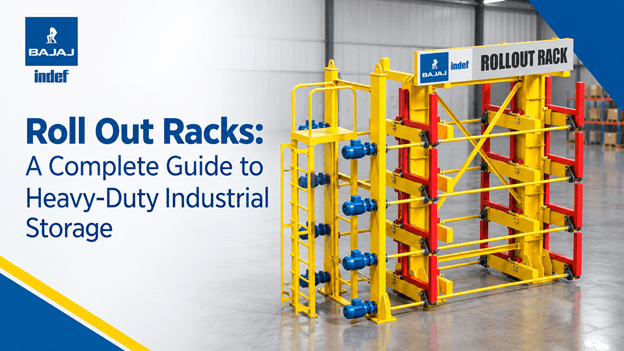
A Roll Out Rack is an industrial storage system designed to store materials vertically, one above another, using drawer-like storage levels that can move in and out of the rack structure.
The concept is similar to a heavy-duty chest of drawers. Each drawer or storage level provides a dedicated location for material, while the roll-out mechanism allows the stored material to be brought toward the operator for loading or retrieval.
Unlike conventional storage arrangements where materials may remain stacked on the floor or placed behind other materials, a Roll Out Rack is designed to provide more direct access to individual storage levels.
This makes it particularly useful for industrial materials such as:
- Pipes and tubes
- Steel bars and sections
- Sheets
- Channels
- Dies and moulds
- Rolled sections
- Long components
- Tools and other industrial items
Bajaj INDEF describes its Roll Out Rack as a customised product, with the rack’s length, width, number and height of levels designed according to customer requirements.
How Does a Roll Out Rack Work?
The basic operating principle is straightforward. Material is placed on an individual storage level or drawer. When that material is required, the drawer is moved outward using the rack’s mechanism. This brings the material into a more accessible position for handling.
After loading or retrieval, the drawer is moved back into the rack. The result is a storage process based on three simple principles:
Store vertically → bring the required level outward → access the material.
This approach can be particularly valuable where floor space is limited but the facility has unused vertical space.
For applications involving long or heavy materials, the extended storage level can also make it easier to position material for handling with an overhead crane, depending on the installation and handling arrangement. Bajaj INDEF specifically highlights easier crane-based removal because the material can be accessed without the need for cross-pulling.
Why Choose Heavy Duty Roll Out Racks for Industrial Storage?
The biggest limitation in many industrial storage areas is not necessarily the total amount of available space but it is how efficiently that space is used. Materials stored horizontally across the floor can occupy valuable working areas. Storing different materials on top of one another can also make selective retrieval difficult. Heavy Duty Roll Out Racks address this by creating defined vertical storage levels while maintaining access to individual storage positions.
1. Better utilisation of vertical space
A Roll Out Rack can be configured with multiple storage levels, allowing material to be stored vertically rather than spreading it across the floor. Some Roll Out Rack can be designed up to 5 metres in height, with the number and height of levels customised according to the application. This means the storage system can be designed around the available building height instead of relying only on floor area.
2. Easier access to individual materials
Selective retrieval is one of the major advantages of a drawer-based storage arrangement. Instead of shifting several materials to reach the required component, the relevant storage level can be rolled out. This can help reduce unnecessary material movement and make the retrieval process more organised. For manufacturing facilities where different sizes of bars, pipes, sheets or components are stored together, this can translate into a more systematic material-handling workflow.
3. High-load industrial storage
Roll Out Racks are intended for industrial applications where conventional light-duty shelving may not be appropriate. The rack should be designed according to the actual material weight, dimensions, storage levels and handling method rather than selecting a standard rack based only on nominal capacity.
4. Less dependence on floor storage
Floor storage can make an industrial area harder to navigate and can create unnecessary material movement. By shifting storage vertically, a Roll Out Rack can help release floor space for production, movement and other operational activities. The exact space saving depends on the existing storage method, material dimensions, rack configuration and available building height. Therefore, instead of promising a universal percentage of space savings, the right approach is to calculate the before-and-after storage footprint for the specific facility.
5. Better material organisation
A storage system becomes more valuable when it improves not only capacity but also visibility and accessibility. Individual Roll Out Rack levels can be assigned to specific material categories, dimensions or production requirements. This can make it easier for operators to identify where material is stored and retrieve it when required. For facilities handling multiple profiles or components, this can support better inventory discipline and reduce the time spent searching through mixed stacks.
Roll Out Cantilever Rack: When Is It Useful?
A Roll Out Cantilever Rack combines the accessibility of a roll-out storage system with the flexibility required for long or irregularly shaped materials. This configuration is particularly relevant when the stored material extends beyond the footprint of conventional shelving. Pipes, bars, tubes, profiles and similar long components can benefit from a storage design where the material has dedicated support while the storage level can be moved outward.
The key distinction is accessibility. A conventional cantilever arrangement provides horizontal support for long materials. A roll-out cantilever configuration adds a mechanism that allows the storage level to move outward, bringing the material into an accessible working position.
This can be particularly useful in manufacturing environments where:
- Long materials need selective retrieval.
- Materials are handled using overhead cranes.
- Floor storage is consuming valuable working space.
- Different material sizes need dedicated storage positions.
- Operators need easier access to stored profiles.
How Much Storage Space Can a Roll Out Rack Save?
There is no single space-saving percentage that applies to every Roll Out Rack installation. The actual benefit depends on what the facility is replacing.
For example, a workshop currently using floor stacks may be able to move several storage levels vertically and recover floor area that can subsequently be used for production, movement or other activities.
The more useful metric is therefore storage density per square metre of floor area. Before installing a Roll Out Rack, businesses can compare:
Existing floor area used for storage → proposed rack footprint → additional vertical storage capacity → recovered floor area.
Choosing Roll Out Racks in India
When evaluating Roll Out Racks in India, buyers should look beyond the basic rack dimensions and focus on the complete storage application.
The right system should answer five questions:
- What material needs to be stored?
- What is the maximum weight per storage level?
- What are the material dimensions and lengths?
- How frequently will the material be retrieved?
- How will the material be loaded and unloaded?
A customised system is particularly important for heavy industrial applications because capacity, dimensions and storage levels need to work together.
This is also why businesses searching for Roll Out Racks manufacturers in India should evaluate the manufacturer’s ability to understand the application and engineer the storage solution accordingly, not simply compare rack prices.
Conclusion
Industrial storage is no longer just about finding a place to keep material. The right storage system should help businesses use available space intelligently, access material efficiently and integrate storage with the wider material-handling process. Roll Out Racks achieve this by combining vertical storage, dedicated storage levels and a roll-out mechanism that brings stored material closer to the operator.
Frequently Asked Questions
1. What is a Roll Out Rack used for?
A Roll Out Rack is used for organised vertical storage of industrial materials such as pipes, tubes, bars, sheets, channels, dies and moulds. Its roll-out storage levels provide easier access to individual materials while helping reduce dependence on floor storage.
2. Can Roll Out Racks be customised?
Yes, Roll-Out Racks can be customized based on factors such as material dimensions, load requirements, rack height, number of levels, and storage configuration. If you want to maximize your space, contact Bajaj Indef experts for smart roll-out racks.
3. Are Roll Out Racks suitable for long materials?
Yes, Roll Out Racks can be configured for long industrial material handling situation, including pipes, bars, tubes and rolled sections. Multiple Roll Out Racks can also be connected for storing materials.
Copyrights © 2026 - All rights reserved
Get connected