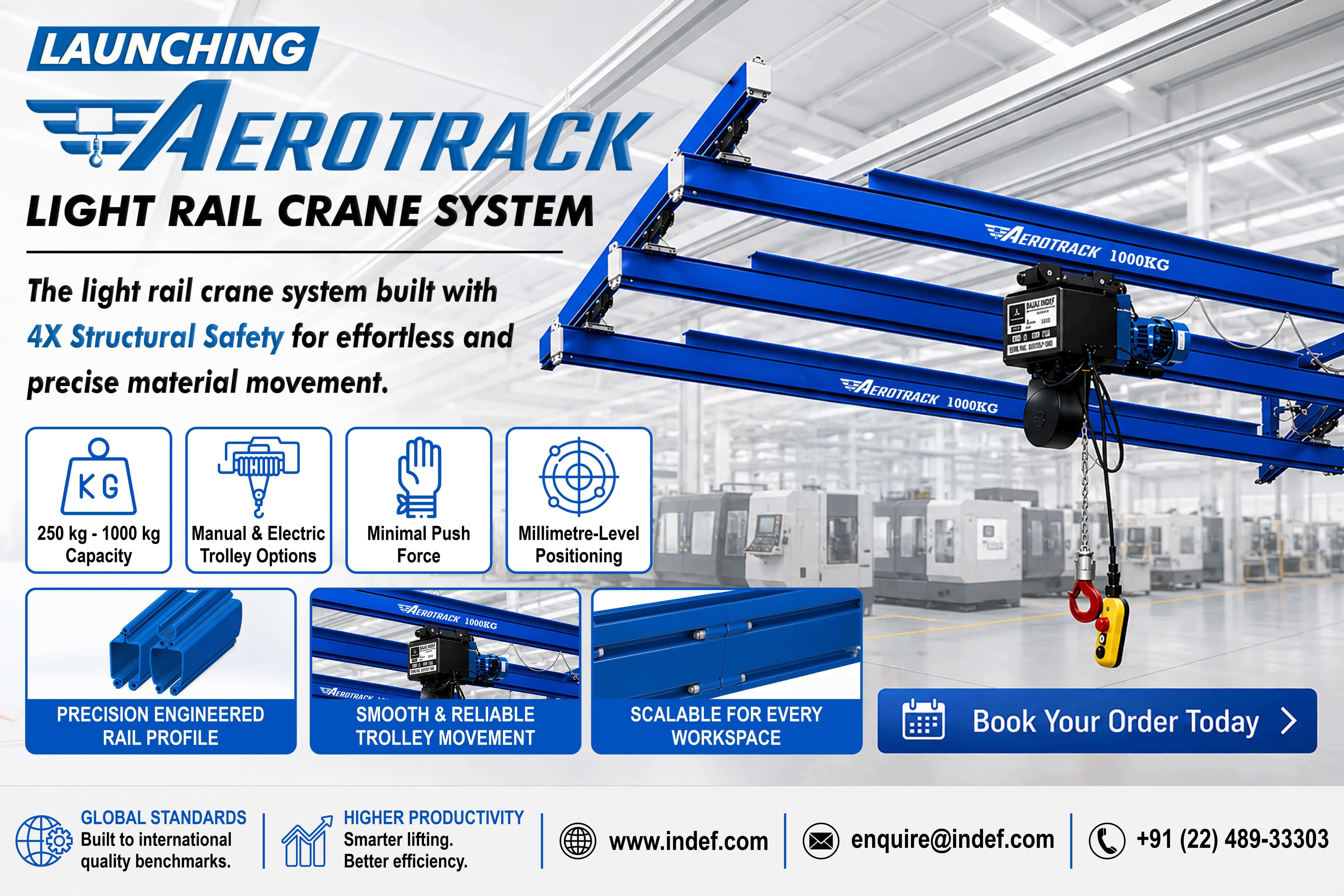
Light Rail Profile Crane: Complete End-to-End Guide 2026
Are you looking for a practical way to handle loads up to 2 tons at your workstation or production line? A Light Rail System provides a flexible overhead material handling solution for lifting, moving and positioning loads within defined work areas.
With decades of experience in material handling systems, Bajaj Indef offers solutions designed for different industrial applications and workstation requirements. Light Rail Profile Crane Systems are commonly used for handling components, loading and unloading, assembly operations and moving materials from one location to another within a manufacturing facility.
What is Light Rail profile Crane?
A LR Profile crane is an enclosed track station called profile that carries bridge and a hoist trolley. The reason for using profile is to bring stability with horizontal force applied with electric chain hoist. People in the manufacturing industry use various names for these cranes – light crane system, workstation crane, profile crane, enclosed track crane and light rail crane.
Most workstations use Light crane system for the production line with lifting capacity upto 2 Tons. But this is not just it, there are alot more to know about the workstation cranes which you need to know.
The system generally consists of:
- Runway profiles: Parallel tracks installed over the required working area.
- Bridge girder: Spans between the runways and carries the trolley.
- Trolley: Travels along the bridge and carries the lifting equipment.
- Suspension system: Connects the runway profiles to the building structure or a freestanding frame.
- Hoist: Lifts and lowers the load. Depending on the application, this can be a chain pulley block, electric chain hoist, balancer or other suitable lifting equipment.
Types of Light Rail Profile Crane Systems
Light Rail Profile Crane Systems can be configured according to the required load movement and workstation layout.
- Workstation Bridge Crane: A workstation bridge crane provides coverage over a defined rectangular work area. The bridge travels along two parallel runway profiles, while the trolley moves across the bridge. It is suitable for assembly stations, machine loading and unloading, component handling and repetitive lifting applications.
- Monorail Crane System: A monorail crane provides movement along a fixed linear path. Instead of covering a complete rectangular workstation, the lifting equipment follows a predetermined route. It is useful when materials need to move repeatedly between defined points along a production or assembly line.
- Ceiling-Mounted Light Rail Crane: A ceiling-mounted system is suspended from the existing building structure after a suitable structural assessment. Because it does not require floor-standing columns, it can help preserve valuable floor space and is suitable for facilities where the existing structure can safely support the system.
- Freestanding Light Rail Crane: A freestanding light rail crane is supported by its own columns and structure. It is particularly useful where the existing roof or building structure cannot support the crane system or where an independent workstation structure is preferred.
Advantages of Light Crane System
Light rail crane system offers the Indian manufacturing, automotive workshop and assembly lines superior ergonomics, low rolling resistance and reduce operator fatigue. Here are the benefits that you must know before choosing it:
- Ergonomics and safety: A light rail profile crane rolls smoothly inside an enclosed track, so your operator pushes the load instead of dragging it.
- Easy and quick installation: Profiles come cut to length and are bolted together, not welded at site. A ceiling-mounted system hangs from your existing roof steel after a structural check, and a freestanding system stands on its own columns bolted to a level floor.
- Space and headroom: The profiles are compact and hang below the roof steel, so a light crane fits into congested bays and low-ceiling workshops.
- Flexibility: Because it is a modular overhead crane, you can extend the runway, add a bridge or shift the whole system when your plant layout changes.
- Cost-effectiveness: You need no dedicated runway structure. And since loads are pushed by hand, many tasks need no motorized travel drive, which saves on equipment, maintenance and electricity. That makes a light crane system a practical choice for small and medium manufacturers.
- Works alongside your EOT crane: A light crane system runs together with your existing EOT installation and cuts crane waiting time on the assembly line. The EOT crane handles the heavy lifts, and the workstation crane takes the repetitive ones.
How Light Rail System are More Productive?
Light rail system helps in managing the repetitive operations at your workstation. Like EOT crane which enable you to manage heavy lifting, LR profile cuts the waiting time and adds productivity with lifting capacity upto 2 Ton. Do you want to know “HOW”, check out the points below:
- Boost assembly line throughput: A light crane system runs together with your existing EOT installation and cuts crane waiting time on the assembly line.
- One operator per crane lift: Because the push force is so low, one person can lift, move and place the load alone.
- Material moves right at the station: An LR profile light crane system provides smooth, ergonomic overhead handling directly within the work zone for effortless load positioning.
- Steadier output through the shift: Less effort per lift means less operator fatigue, so the last hour of the shift runs closer to the pace of the first.
In short, a light rail crane system gives every workstation its own industrial lifting equipment, so each crane lift happens when your process needs it alongside your overhead crane.
Where Are Light Rail Profile Crane Systems Commonly Used?
Light Rail Profile Crane Systems are commonly considered for:
- Automotive component assembly
- Engineering and manufacturing workstations
- Machine loading and unloading
- Production and assembly lines
- Component handling
- Tool and equipment handling
- Loading and unloading stations
- Material transfer between defined workstations
The appropriate configuration depends on the load, movement pattern, available space and workstation layout.
Choose the Right Light Rail Profile Crane for Your Application
The right Light Rail Profile Crane System depends on your load capacity, span, runway length, lifting height, movement pattern and workstation layout. Bajaj Indef Aerotrack Light Rail Crane System provide smooth load travel with a 4× structural safety & deliver reliable performance with long service life.
Share your application requirements with Bajaj Indef, including the load, span, runway length and lifting frequency, to determine the appropriate configuration for your workstation.
Frequently Asked Questions
1. What is a light rail profile crane?
A light rail profile crane is a modular overhead crane that runs on enclosed aluminium or steel track profiles. It typically lifts up to 2,000 kg at a workstation or along a production line, and the operator moves the load by hand.
2. How does a light rail crane improve productivity?
It lets one operator lift and place heavy parts without waiting for the bay crane. This eliminates the work of two and brings productivity at workplace.
3. What is the difference between a light rail crane and an EOT crane?
A light rail crane lifts to about 2 tons, hangs from existing roof steel or a freestanding frame, and is pushed by hand. An EOT crane lifts 1 ton to 100 tons above and needs dedicated runway girders.
Copyrights © 2026 - All rights reserved
Get connected